|
 |
 |
|
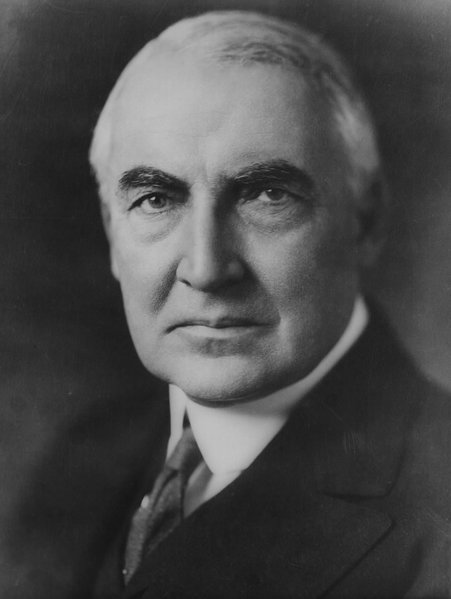
Election of 1920 In the 1920 election, Harding ran against Democrat Ohio Governor James M. Cox, whose vice presidential candidate was Assistant Secretary of the Navy Franklin D. Roosevelt. The election was seen in part as a referendum on whether to continue with the progressive work of the Woodrow Wilson administration or to revert to the laissez-faire approach of the William McKinley era. Harding ran on a promise to "Return to Normalcy," a term he coined, which reflected three trends of his time: a renewed isolationism in reaction to World War I, a resurgence of nativism, and a turning away from the government activism of the reform era. Harding's "front porch campaign" during the late summer and fall of 1920 captured the imagination of the country. Not only was it the first campaign to be heavily covered by the press, and to receive widespread newsreel coverage, but it was also the first modern campaign to use the power of Hollywood and Broadway stars who traveled to Marion for photo opportunities with Harding and his wife. Al Jolson, Lillian Russell, Douglas Fairbanks, and Mary Pickford were among the conservative-minded luminaries to make the pilgrimage to central Ohio. Business icons Thomas Edison, Henry Ford, and Harvey Firestone also lent their cachet to the campaign. From the onset of the campaign until the November election, over 600,000 people traveled to Marion to participate. The campaign owed a great deal to Florence Harding, who played perhaps a more active role than any previous candidate's wife in a Presidential race. She cultivated the relationship between the campaign and the press; as the business manager of the Star, she understood reporters and their industry and played to their needs by making herself freely available to answer questions, pose for pictures or deliver home cooked food from her kitchen to the press office, a bungalow she had constructed at the rear of their property in Marion. Mrs. Harding even went so far as to coach her husband on the proper way to wave to newsreel cameras to make the most of coverage. The campaign also drew upon Harding's popularity with women. Considered handsome, Harding photographed well compared to Cox. However, it was Harding's support for women's suffrage in the Senate that made him extremely popular with women: the ratification of the 19th Amendment to the Constitution in August 1920 brought huge crowds of women to Marion, Ohio to hear Harding. During the campaign, rumors were spread by persons (unaffiliated with the Cox campaign) that Harding's great-great-grandfather was a West Indian black and that other blacks lurked in his family tree (see Scandals, below). In response, Harding's campaign manager said, "No family in the state [of Ohio] has a clearer, a more honorable record than the Hardings, a blue-eyed stock from New England and Pennsylvania, the finest pioneer blood." To a friend, however, Harding confided that one of his ancestors may have "jumped the fence", although Harding himself was never certain whether or not this was true. These rumors, perhaps based on no more than local gossip, were circulated maliciously by William Estabrook Chancellor. The milestone election of 1920 was the first in which women could vote nationwide. Harding received 61 % of the national vote and 404 electoral votes, an unprecedented margin of victory. Cox received 36 % of the national vote and 127 electoral votes. Socialist Eugene V. Debs, campaigning from Federal prison, received 3 % of the national vote. Cabinet |
|
|
|
|
||